
The essential context.
- Sermorelin is associated with GHRH-(1–29) biology.
- A change in hormone measurements is not itself a sporting outcome.
- Study identity, participant context and product identity must remain distinct.

Identify the biological question
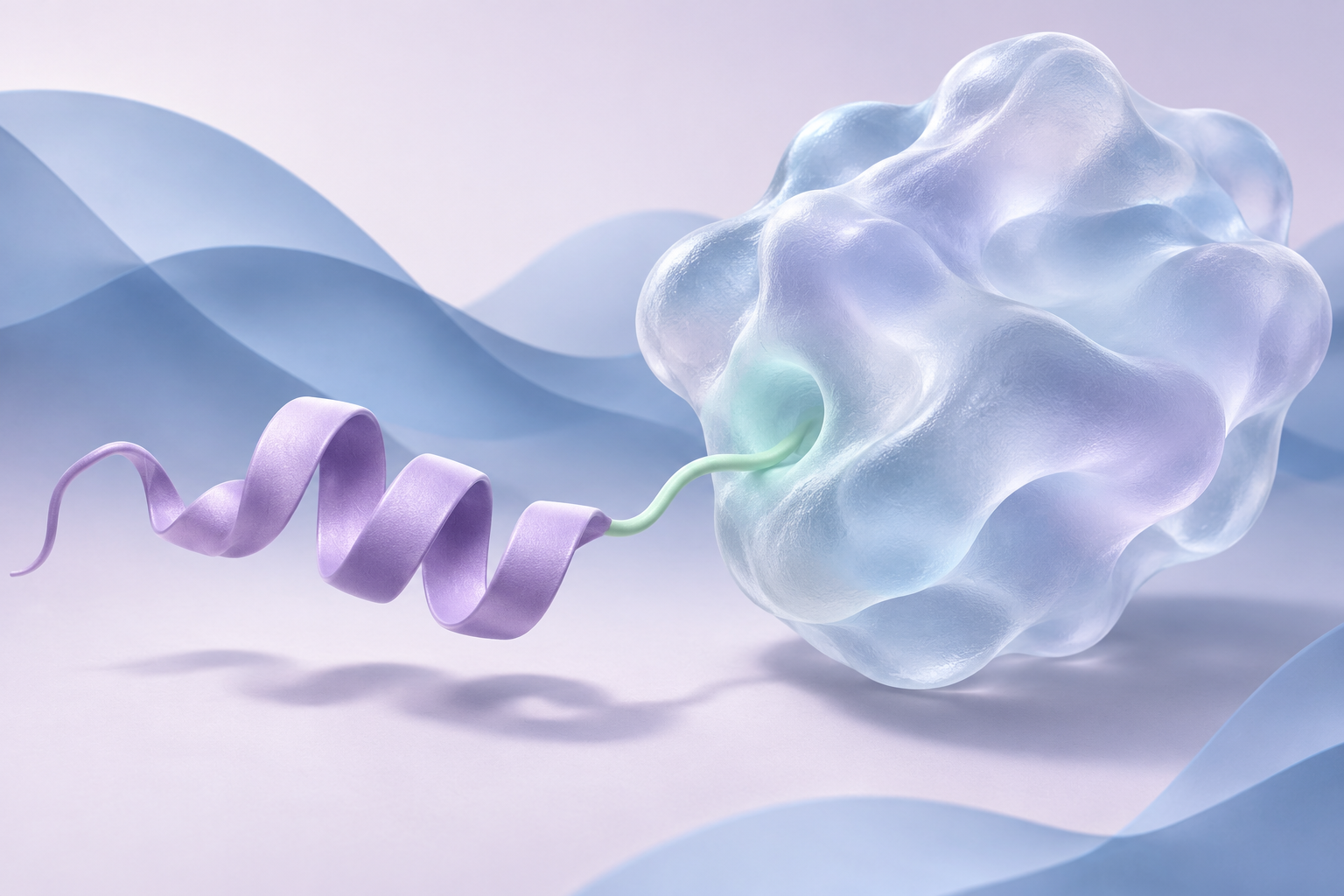
Sermorelin is commonly associated with the GHRH-(1–29) peptide and research into stimulation of the body's growth-hormone signalling. The useful starting point is the GHRH pathway rather than a broad promise of hormone optimisation. That starting point also separates the topic from compounds discussed through ghrelin-receptor biology, such as Ipamorelin and Ibutamoren.
A downstream GH connection does not make those compounds chemically equivalent or equally studied. Before comparing them, establish which material, receptor question and endpoint each paper concerns. A catalogue can make these distinctions accessible without presenting an endocrine mechanism as a reason for personal use or as a shortcut to a sporting result.
A route through the evidence
A conceptual reading map for this topic.
GHRH identity
Define the material
Human research
Keep the population attached
Open outcomes
No automatic sporting extrapolation
What the early human work examined
Corpas and colleagues studied GHRH-(1–29) endocrine responses in older men in 1992. Their question concerned GH and IGF-I measurements in that setting. It should remain an endocrine research finding rather than being expanded into a general claim of improved recovery, anti-ageing or athletic performance.
The publication's participant context matters as much as its molecule name. An older study can still be informative when its design and limits are clearly stated. It becomes misleading when the population disappears from the summary or when an observed signal is treated as proof of an outcome the study did not test.
Function needs its own assessment
Vittone and colleagues' 1997 GHRH-(1–29) study in older men examined hormone, body-composition and selected functional or metabolic questions. It illustrates why several endpoints can be investigated together without becoming synonymous. A favourable hormone measurement does not make every other result favourable, and a small study does not resolve every practical question.
For readers interested in sport, the next question is whether a relevant sporting population and task were actually assessed. Differences in age, baseline endocrine status and physical condition can matter to interpretation. Those differences are not minor details that a product page can discard to create a simpler comparison.
Do not merge Sermorelin with CJC labels
CJC-1295 DAC, an unspecified CJC-1295 presentation and Sermorelin should not be treated as spelling variants of the same research material. Teichman and colleagues' 2006 study concerned a long-acting CJC-1295 construction. It belongs in its own evidence context, even when it appears nearby in a catalogue of GHRH-related compounds.
Similarly, a label that names Sermorelin but does not resolve exact identity or formulation cannot inherit all properties from a familiar paper. A useful product description states the labelled amount, presentation and source information separately from the research overview. These are complementary records with different jobs.
Open questions deserve precise wording
The relevant uncertainties include how well a particular result transfers to another population, which outcomes were followed and whether the actual product has been identified and documented. Safety questions require appropriate clinical assessment and follow-up; the absence of a claim in a short abstract does not answer them. A growth-hormone-related mechanism should not be described as automatically free of wider endocrine consequences.
Read the linked GHRH comparison for the mechanism distinctions and the batch-report guide for document interpretation. Neither replaces the original research or authenticates an individual vial. The value of this overview is to keep those boundaries visible while making the existing human research easier to understand.
Sources & further reading
Key publications are named below. The article explains their design, study population and limitations, keeping laboratory findings, clinical results and sports claims in context.
- 01 Corpas et al., GHRH-(1–29) endocrine study, JCEM, 1992; DOI 10.1210/jcem.75.2.1379256
- 02 Vittone et al., GHRH-(1–29) study in older men, Metabolism, 1997; DOI 10.1016/S0026-0495(97)90174-8
- 03 Teichman et al., CJC-1295 studies in healthy adults, JCEM, 2006; DOI 10.1210/jc.2005-1536
Dr. Monica Tatem
Dr. Monica Tatem earned her Ph.D. in Molecular Pharmacology from a leading medical university, followed by postdoctoral research focused on anabolic pathways and cellular signaling. Her scientific work encompasses a comprehensive...
View author profile