

The essential context.
- DAC enables albumin association, making molecular identity important when interpreting persistence.
- Early human studies demonstrated GH and IGF-I changes; these markers do not establish broad clinical benefits.
- The longer-acting research compound is not automatically interchangeable with an unspecified no-DAC product.
The starting point: a GHRH analogue
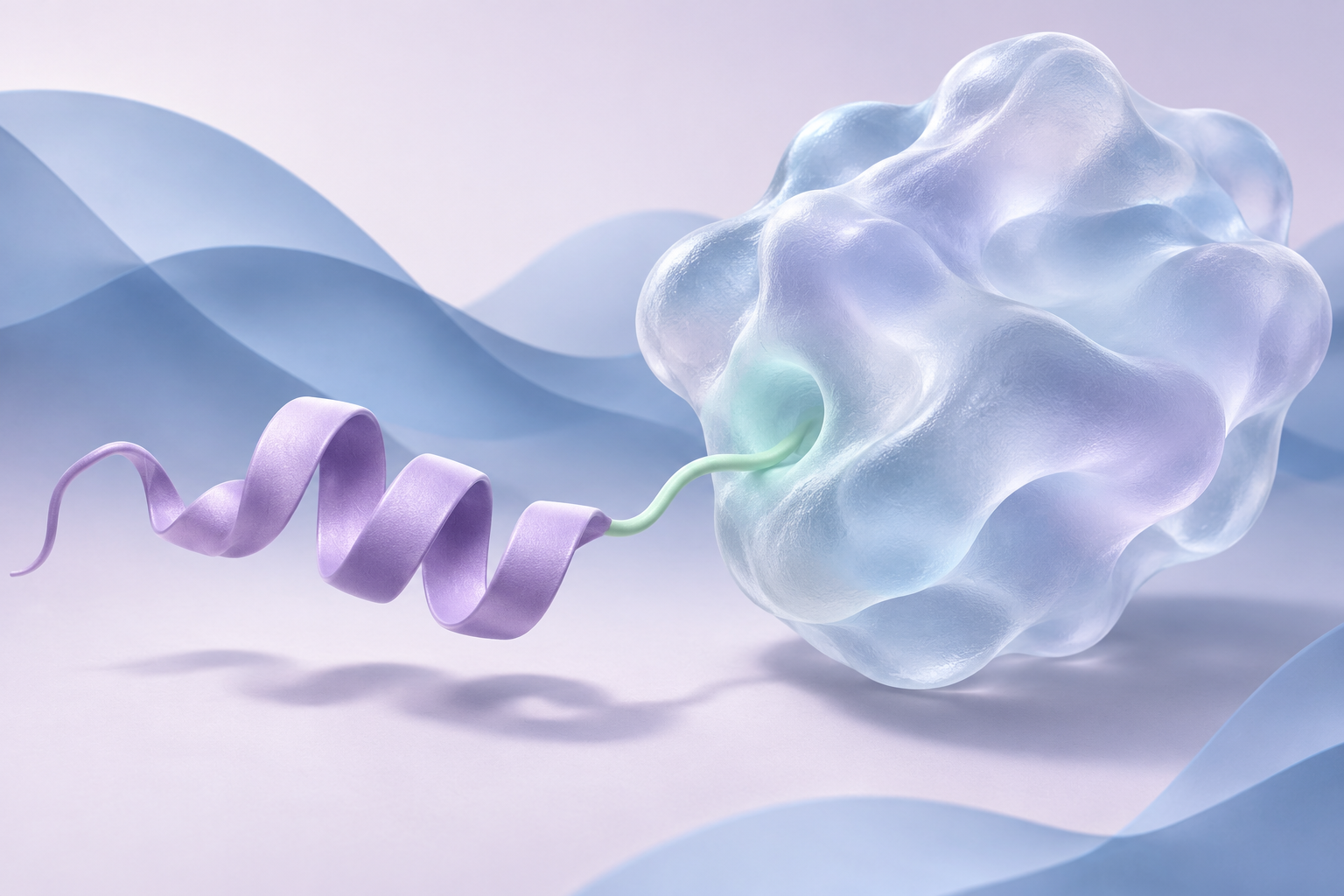
CJC-1295 was developed from the growth-hormone-releasing-hormone pathway. GHRH acts at the pituitary to influence growth-hormone secretion. The research design modifies a GHRH-derived peptide and adds a reactive component intended to associate with albumin. This is usually discussed as DAC, or drug affinity complex.
The distinction is chemical, not merely a difference in a product’s display name. An FDA scientific assessment describes DAC and non-DAC CJC-1295-related substances as distinct active moieties and discusses several salt forms. A catalogue therefore needs the exact specification rather than relying on the short label “CJC”.
From molecular design to the evidence boundary
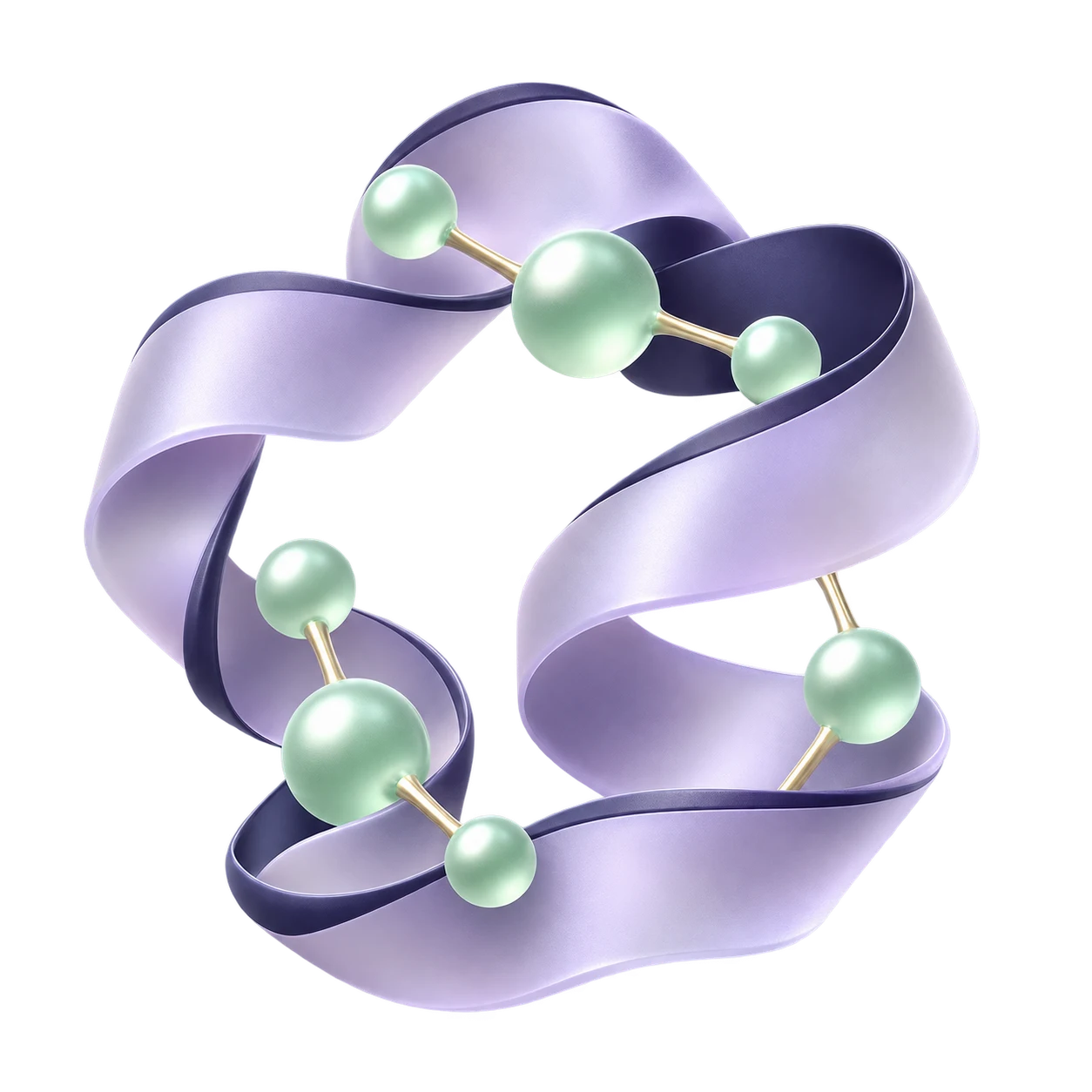
The map separates molecular engineering from the outcomes actually studied.
CJC-1295 with DAC
A specified GHRH analogue with a reactive component
Albumin association
A design investigated to prolong circulating exposure
Early human measurements
GH, IGF-I, pharmacokinetics and pulsatility
Clinical evidence boundary
Marker changes do not establish lasting patient benefit
What albumin binding changes
The original development work investigated peptide bioconjugation to albumin and showed that the resulting material retained activity at the GHRH receptor in experimental systems. This carrier-binding approach was designed to prolong exposure compared with the short-lived starting peptide. It connects molecular engineering with a measurable pharmacokinetic question.
Persistence and potency are different. Longer detectability does not by itself establish a desirable clinical outcome. Interpretation also depends on the assay, the identity of the measured material and the biological responses assessed. The carrier concept explains why a molecular modification cannot be ignored when comparing research papers.
What the early human trials measured
A 2006 publication reported two randomised, placebo-controlled, double-blind studies in healthy adults. Their observation periods were 28 and 49 days, and the main measurements included GH, IGF-I and pharmacokinetic parameters. Sustained hormone responses were observed, with an estimated compound half-life of approximately 5.8–8.1 days under those study conditions.
These are human pharmacology findings, not a broad clinical-effectiveness programme. Healthy volunteers are not interchangeable with people who have endocrine disease or other conditions. A hormone-concentration change does not by itself demonstrate better physical function, body composition, recovery or longevity.
Sustained stimulation and hormone pulses
A separate 2006 investigation examined GH secretion using repeated overnight sampling before and after CJC-1295 exposure. Pulsatile secretion persisted despite the prolonged stimulus. That matters because average concentration and secretion pattern describe different aspects of endocrine behaviour; one cannot replace the other.
The observation does not show that every aspect of physiological regulation remains normal under all circumstances. It describes the secretion behaviour measured in a small, defined research setting. Claims such as “fully natural hormone regulation” extend beyond what that experiment can demonstrate.
Exploratory protein measurements are another evidence level
A later study analysed serum from 11 healthy young men before and after CJC-1295 exposure to explore protein-profile changes. This can identify downstream signals and generate hypotheses. It cannot turn a group of laboratory changes into proof of a patient-important outcome.
More biological measurements do not automatically mean stronger clinical evidence. Exploratory findings require confirmation, and a candidate marker must be linked to a meaningful outcome before supporting a practical health claim. This distinction is particularly relevant when a molecule is described using broad “anti-ageing” language.
With DAC and no-DAC labels need separate evidence
The long-acting compound in the classic human papers has a particular molecular design. A product labelled “without DAC” should not inherit the same persistence estimates merely because CJC-1295 appears on both labels. Exact identity and relevant comparative evidence are required.
Naming a salt form does not settle every question about formulation, stability or quality. Batch documents must be linked to the actual material. They can support specific analytical statements, while the clinical interpretation remains attached to the formulation actually studied.
| Question | Relevant evidence | Conclusion boundary |
|---|---|---|
| What is the substance? | Sequence, modifications and salt form | A short name does not establish equivalence |
| Does the design prolong exposure? | Compound-specific pharmacokinetics | Persistence is not patient benefit |
| Does it affect GH/IGF-I? | Early human hormone measurements | Markers are not broad efficacy outcomes |
| Does another product behave identically? | Direct identity and comparative data | No automatic transfer to no-DAC labels |
What remains to be established
Useful further evidence would examine defined populations, relevant clinical outcomes and appropriately long follow-up, using a fully specified product and a suitable comparison. It should explain how laboratory changes relate to a claimed benefit, rather than treating a marker change as a benefit by definition.
The studies discussed here do not authenticate a retail item or determine its legal status in a particular market. A research publication, an administrative assessment and a product authorisation are different records. Each should be described according to its actual purpose.
Frequently asked questions
Is CJC-1295 DAC the same as growth hormone?
No. It is a GHRH-pathway analogue studied for effects on endogenous hormone secretion. The analogue and the hormone it influences are different molecules.
Can the half-life be applied to a no-DAC product?
Not without establishing the relevant molecular identity and pharmacokinetics. The binding modification is central to the longer-acting research design.
Does higher IGF-I establish better recovery?
No. A marker response shows a biological effect. A recovery claim needs direct evidence using suitable functional or clinical outcomes.
Does preserved pulsatility prove long-term safety?
No. That study addresses a particular secretion pattern. It cannot replace safety evaluation across populations and longer follow-up.
Sources & further reading
Follow the original publications and records behind this overview. Each source answers a specific question; no single record establishes every aspect of a compound or product.
- 01 Jetté et al. (2005): albumin-binding GHRH analogues and identification of CJC-1295
- 02 Teichman et al. (2006): early randomised CJC-1295 studies in healthy adults
- 03 Ionescu and Frohman (2006): GH pulsatility during CJC-1295 stimulation
- 04 Primary study (2009): exploratory serum-protein changes after CJC-1295
- 05 FDA (2024): CJC-1295-related substances and the distinction between DAC and non-DAC active moieties
Dr. Monica Tatem
Dr. Monica Tatem earned her Ph.D. in Molecular Pharmacology from a leading medical university, followed by postdoctoral research focused on anabolic pathways and cellular signaling. Her scientific work encompasses a comprehensive...
View author profile