
The essential context.
- Start with molecular identity, not the shop category.
- A common sporting claim does not establish a common target.
- Study material and a catalogue item require separate verification.
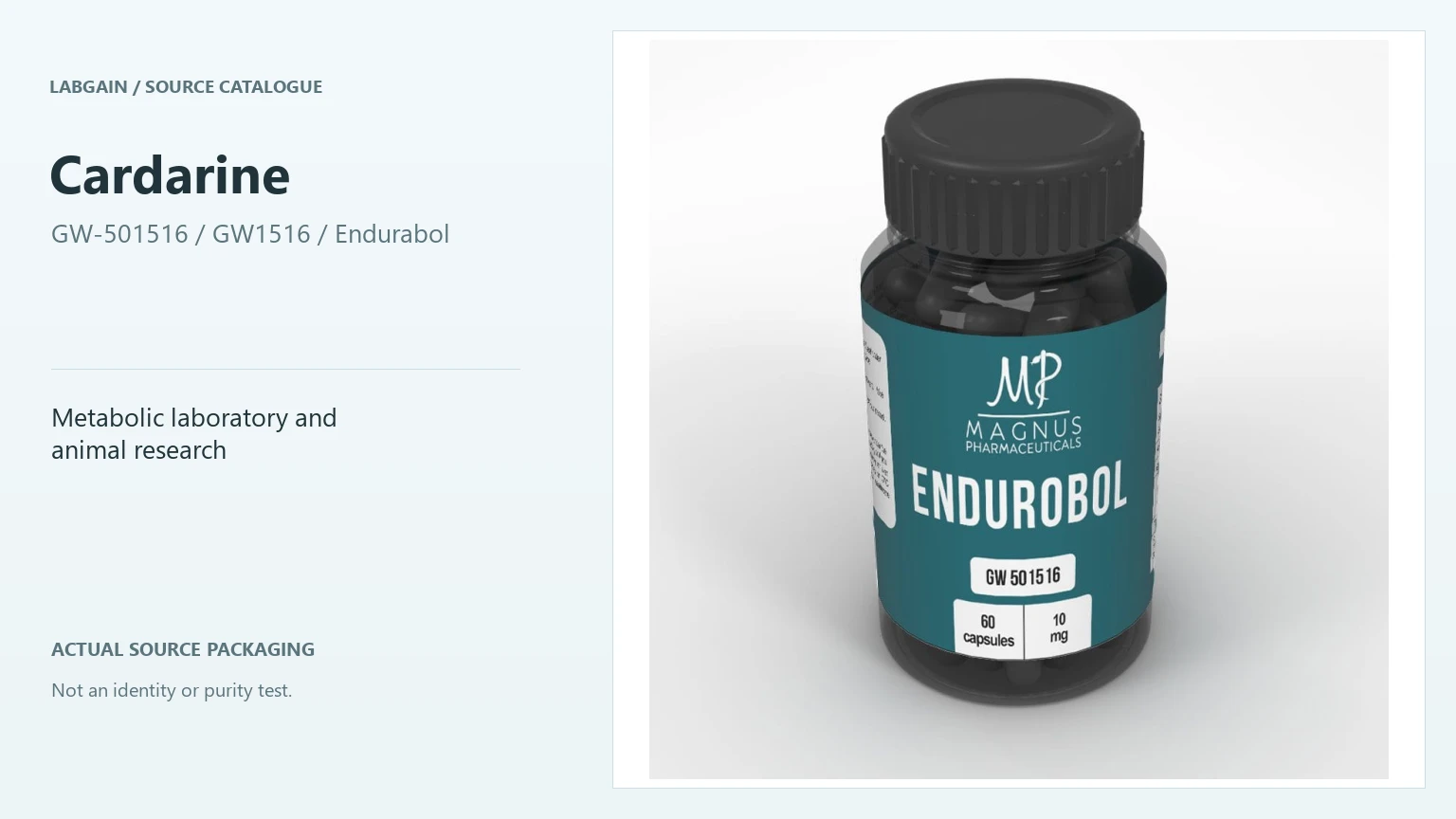
Start with the question behind the name
A catalogue groups items so that people can find them. Pharmacology groups molecules by what they interact with and what the experiments actually demonstrate. Those purposes overlap only partly. When a category contains both SARMs and related compounds, the heading should be read as navigation, not a statement that every item works through an androgen receptor.
Before comparing products, write down the molecule, its alternative names, the proposed target and the type of evidence available. Keep the product photograph and labelled amount on a separate line. This small separation prevents a familiar bottle or a shared abbreviation from doing the work of scientific identification.
A route through the evidence
A conceptual reading map for this topic.
Compound class
Molecule-specific identity
Proposed target
A separate research question
Evidence level
What was actually measured
The androgen-receptor group
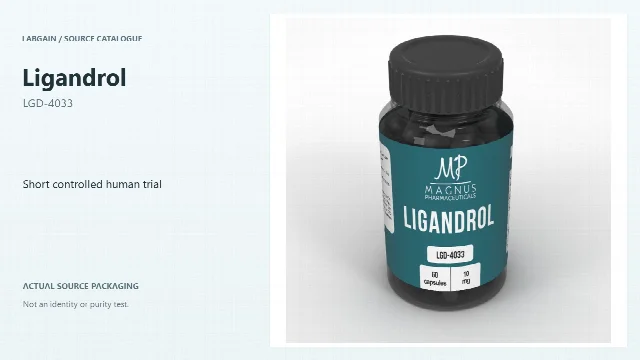
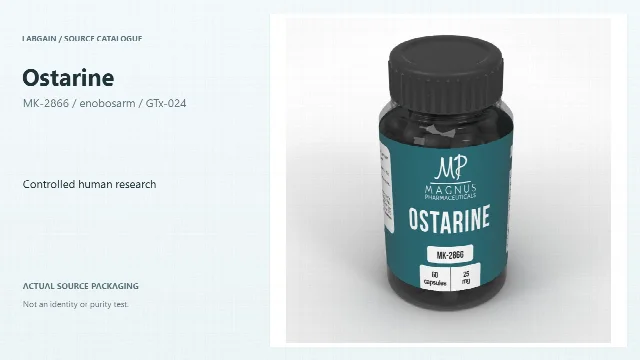
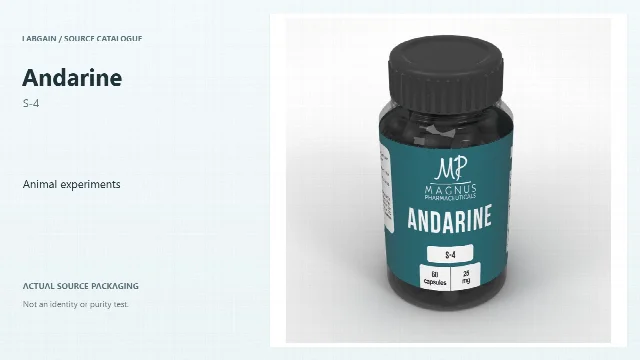
Andarine, Ostarine, Ligandrol, RAD-140 and S-23 are commonly discussed as investigational nonsteroidal androgen-receptor modulators. YK-11 requires a separate structural and evidence discussion rather than being presented as just another equally studied member. For a concrete human example, Basaria and colleagues published a short controlled LGD-4033 study in 2013.
That example cannot provide a class-wide ranking. A result for one molecule, research preparation and population is not a result for every compound carrying the SARM label. Similar names also do not establish equivalent selectivity, exposure, adverse effects or long-term outcomes.
Three different routes outside that group
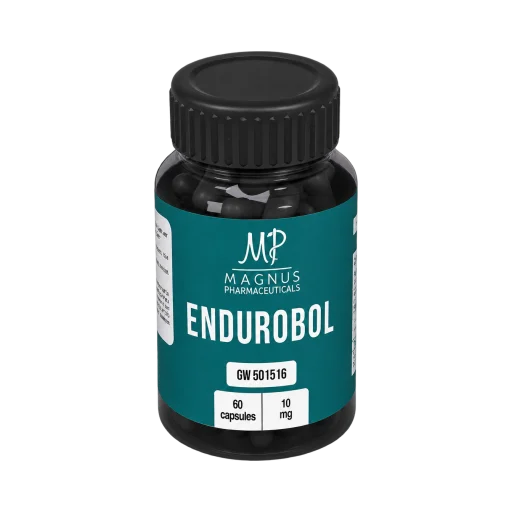
Cardarine refers to GW501516 and PPARδ research; Narkar and colleagues' 2008 work was a laboratory and animal investigation. Ibutamoren, or MK-677, is a ghrelin-receptor agonist and growth-hormone secretagogue, as illustrated by Nass and colleagues' older-adult trial. SR-9009 is associated with REV-ERB experiments; Dierickx and colleagues also demonstrated effects that did not depend on REV-ERB.
These are separate research questions. Describing all three as nonhormonal versions of a SARM would replace their actual identities with a marketing comparison. Even a proposed molecular target is not a complete explanation of every observed effect.
Compare evidence on the same level
A useful comparison states whether the evidence concerns receptor binding, cultured cells, an animal model, hormone measurements, body composition or a patient-relevant outcome. It also asks what happened in the control group and whether the population resembles the person described in the claim. A mechanism paragraph cannot substitute for that information.
Avoid tables that award a universal score for strength, fat loss or safety when their rows come from incompatible experiments. A blank clinical evidence cell is informative. It should stay blank or be described as unresolved rather than being converted into an optimistic numerical rating.
Bring the distinction back to the product page
Product identity remains a separate issue after the mechanism has been clarified. Van Wagoner and colleagues' 2017 chemical analysis of internet-marketed SARMs showed why a category name cannot be used as an analytical result. That historical sample does not measure the quality of any present listing here.
Read a product page in three passes: identify the labelled compound and presentation, examine the research summary, then inspect any batch-linked documentation. Keep disagreements visible, including a photograph whose printed content differs from the listing. This approach supports informed reading without turning the catalogue into a use protocol.
Sources & further reading
Follow the original publications and records behind this overview. Each source answers a specific question; no single record establishes every aspect of a compound or product.
- 01 Basaria et al., LGD-4033 trial, J Gerontol A, 2013; DOI 10.1093/gerona/gls078
- 02 Nass et al., MK-677 body-composition trial, Ann Intern Med, 2008; DOI 10.7326/0003-4819-149-9-200811040-00003
- 03 Dierickx et al., SR9009 target-independent effects, PNAS, 2019; DOI 10.1073/pnas.1904226116
- 04 Narkar et al., AMPK and PPARδ experiments, Cell, 2008; DOI 10.1016/j.cell.2008.06.051
- 05 Van Wagoner et al., internet SARMs composition study, JAMA, 2017; DOI 10.1001/jama.2017.17069
Dr. Monica Tatem
Dr. Monica Tatem earned her Ph.D. in Molecular Pharmacology from a leading medical university, followed by postdoctoral research focused on anabolic pathways and cellular signaling. Her scientific work encompasses a comprehensive...
View author profile