
The essential context.
- Lean mass is a measurement category, not a performance score.
- A statistically detectable change may not be practically meaningful.
- Benefits and adverse effects need the same careful reading.

Begin with the measurement
Lean mass is often treated in sporting discussions as a synonym for new functional muscle. That shortcut makes a study sound more directly relevant to training than it may be. The measurement method, the tissues included and the conditions of assessment all matter. Before interpreting a change, check exactly what the investigators called lean mass and how they measured it.
Then ask whether strength, power, walking ability or another physical task was measured separately. A paper may be designed primarily around body composition and may not have enough participants or follow-up to answer a performance question. Missing performance evidence should not be filled in by assumption.

A route through the evidence
A conceptual reading map for this topic.
Body composition
A defined measurement
Physical function
A separately tested task
Sporting performance
Not inferred from mass alone
A concrete example from MK-677 research
Nass and colleagues' 2008 trial of MK-677 in older adults found that a change in fat-free mass did not establish a corresponding improvement in strength or function. The authors also described limits in the study's ability to assess functional endpoints. The lesson is about keeping outcomes separate, not about predicting one person's response.
When Ibutamoren appears beside Ligandrol in a discussion of lean mass, that shared phrase does not make their mechanisms, populations or risk profiles comparable. A meaningful comparison needs more than a similar label on the vertical axis of two different graphs.
Physical function is still not every sport
The 2011 enobosarm study by Dalton and colleagues included stair-climbing assessment in older adults. A defined function test is more specific than a broad claim of better performance, but it still describes the particular task and population studied. It should not be rewritten as evidence for sprinting, maximal lifting or competitive endurance.
Ostarine and Ligandrol therefore need summaries that retain the original endpoint language. A headline about muscle can be followed by a short explanation of what was measured, what improved, what did not improve and what was not tested. This is more useful than combining several unlike results into a single score.
Statistical significance and useful change
A small change can be measured consistently enough to be statistically distinguishable from a control group. That does not automatically make it large enough to matter in daily function or sport. Conversely, a study that did not detect a difference may be too small to rule out every possible effect. Both questions require the effect estimate and its uncertainty, not just the words significant or nonsignificant.
Check whether the endpoint was planned in advance, whether several outcomes were examined and how missing results were handled. These reading questions help distinguish a supported conclusion from a favourable selection of numbers after the study has finished.
Read the benefit and risk columns together
The outcome that attracts attention should never be detached from tolerability, laboratory findings and withdrawals. A study may detect a body-composition signal while leaving long-term consequences unresolved. The apparent absence of a rare event in a limited sample is not a reliable estimate of its absence in wider use.
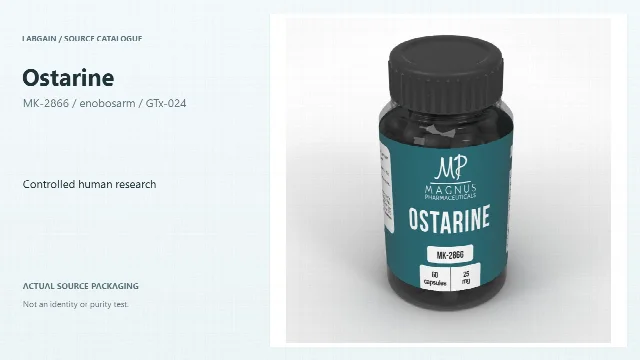
On a product page, the research summary should describe the type of signal rather than promise a sporting result. A related article can explain the endpoint in more detail; the catalogue can document labelled content and product-specific information. Neither a bottle image nor a retail price can resolve the gap between a research measurement and a personal performance expectation.
Sources & further reading
Follow the original publications and records behind this overview. Each source answers a specific question; no single record establishes every aspect of a compound or product.
- 01 Nass et al., MK-677 body-composition trial, Ann Intern Med, 2008; DOI 10.7326/0003-4819-149-9-200811040-00003
- 02 Dalton et al., GTx-024 phase II trial, JCSM, 2011; DOI 10.1007/s13539-011-0034-6
- 03 Basaria et al., LGD-4033 trial, J Gerontol A, 2013; DOI 10.1093/gerona/gls078
Dr. Monica Tatem
Dr. Monica Tatem earned her Ph.D. in Molecular Pharmacology from a leading medical university, followed by postdoctoral research focused on anabolic pathways and cellular signaling. Her scientific work encompasses a comprehensive...
View author profile