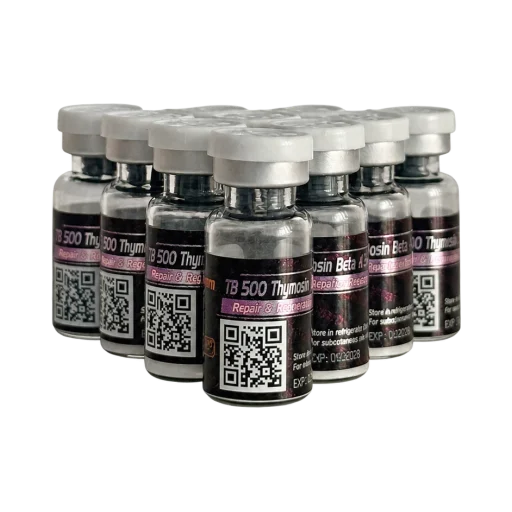

The essential context.
- The TB-500 name does not prove a product’s sequence.
- Wound and eye studies do not demonstrate sports-injury recovery.
- The 2026 WADA List prohibits thymosin beta-4 derivatives such as TB-500 at all times.

Why athletes encounter the name TB-500
The attraction is easy to understand: persistent soft-tissue symptoms can make an athlete hope for a more dependable recovery. Online discussion often describes TB-500 as supporting repair across tendons, muscle and connective tissue. That broad language can hide the absence of a defined injury, verified ingredient and meaningful comparison.
There is also an identity problem. A catalogue name may refer to a fragment, a full-length peptide or an inadequately characterised preparation. Describing claimed sports use is different from confirming that similarly named products contain the material investigated in a particular paper.
Four questions behind repair claims
Evidence map, not a treatment sequence.
Identity
Which sequence and formulation?
Study setting
Horses, wounds or eye disease?
Sports outcome
Function and return to sport need direct study
Safety and rules
Uncertain systemic risks; explicit WADA prohibition
What the analytical work established
Ho and colleagues’ 2012 Journal of Chromatography A paper studied a veterinary preparation called TB-500. It identified an N-terminal-acetylated seven-amino-acid region associated with thymosin beta-4 and developed analytical methods in horses. This provides evidence about the tested preparation’s identity, not its effectiveness in injured athletes.
Full-length thymosin beta-4 contains 43 amino acids. A shared sequence region does not make the fragment interchangeable with that molecule. A paper on one material cannot establish the effects, exposure or safety of the other, and neither establishes the composition of an untested vial.
Human studies often carried across incorrectly
Guarnera, DeRosa and Camerini’s 2010 phase II study involved 73 patients with venous leg ulcers. It investigated a topical full-length thymosin beta-4 formulation alongside wound care. Exploratory healing findings in that condition are relevant to further wound research, not a demonstration of faster muscle or tendon recovery in sport.
Sosne and Ousler’s 2015 study involved 72 participants with dry-eye disease and an ophthalmic thymosin beta-4 formulation. Eye-surface outcomes and local tolerability cannot establish the safety of a separate systemic sports preparation. Population, formulation and endpoint belong beside the molecule’s name.
What could count as a genuine advantage
A useful sports advantage would be a reproducible improvement in function, tissue integrity or safe return to activity, beyond an appropriate rehabilitation comparison. None of the cited studies establishes that outcome for TB-500. Repair biology offers a hypothesis, not a measured number of training days saved.
The claim should distinguish pain relief, stronger healed tissue and prevention of another injury. These outcomes can move differently. An improved subjective feeling without adequate load tolerance would not necessarily be a favourable sporting result.
| Claim | Research context | Sports interpretation |
|---|---|---|
| Tendon or muscle repair | Analytical identity and related-peptide biology | Controlled athlete benefit unestablished |
| Human wound-healing proof | Full-length peptide in venous ulcers | Different tissue, formulation and condition |
| Known safety | Limited formulation-specific studies | No general TB-500 safety guarantee |
Uncertainties and practical downsides
Long-term systemic effects, uncommon adverse reactions and interactions in healthy training populations are not adequately defined by this evidence. Repair pathways participate in many biological processes. A mechanism such as angiogenesis should not be interpreted as uniformly beneficial or harmless. Conversely, uncertainty is not proof of a particular cancer outcome.
Unverified sequence, impurities, inaccurate content and microbial contamination are separate product risks. Combining recovery substances makes an adverse event or apparent benefit harder to attribute. Continuing to train through unexplained weakness, swelling or pain can also obscure the original injury rather than resolve it.
A recovery claim needs a precise endpoint
Recovery can mean closing a skin wound, relieving a symptom, regaining strength or completing a full sporting season without another injury. These endpoints are not interchangeable. The venous-ulcer and dry-eye studies each addressed a narrowly defined clinical question with a particular formulation. Neither measured the load-bearing capacity of an injured athlete’s tendon.
A fair evaluation therefore asks whether the actual claim matches the tissue, molecule and endpoint in the cited paper. It also asks whether an observed improvement persists under realistic activity and whether harms were systematically recorded. This discipline does not dismiss repair biology; it prevents a useful research observation from becoming a much broader promise than the experiment supports.
Anti-doping status and the overall balance
WADA’s 2026 List explicitly includes thymosin beta-4 and its derivatives, with TB-500 as an example, under S2.3. The prohibition applies in and out of competition. A claim that a substance is intended only for recovery does not change that rule or establish medical eligibility.
TB-500 consequently has a prominent recovery narrative but no established athlete benefit in the cited evidence. Better research would need a verified sequence, specific injury, controlled comparison, relevant function and sufficient safety follow-up. Potential repair effects should remain research questions rather than promised sporting advantages.
Frequently asked questions
Is TB-500 another name for full-length thymosin beta-4?
Not reliably. The analytical paper identified an acetylated fragment in the tested TB-500 preparation; the full-length peptide is a different molecule.
Do wound and eye studies prove faster sports recovery?
No. They studied different formulations and conditions without establishing return-to-sport benefit.
Does a recovery purpose override the WADA rule?
No. A stated purpose does not itself create an exception to the 2026 prohibition.
Sources & further reading
Key publications are named below. The article explains their design, study population and limitations, keeping laboratory findings, clinical results and sports claims in context.
- 01 Ho et al. (2012), Journal of Chromatography A: analytical identity of TB-500 in an equine preparation; PMID 23084823
- 02 Guarnera, DeRosa & Camerini (2010), Annals of the New York Academy of Sciences: full-length thymosin beta-4 in venous ulcers; PMID 20536470
- 03 Sosne & Ousler (2015), Clinical Ophthalmology: 72-participant thymosin beta-4 dry-eye trial; PMID 26056426
- 04 WADA (2026): Prohibited List, S2.3
Dr. Monica Tatem
Dr. Monica Tatem earned her Ph.D. in Molecular Pharmacology from a leading medical university, followed by postdoctoral research focused on anabolic pathways and cellular signaling. Her scientific work encompasses a comprehensive...
View author profile