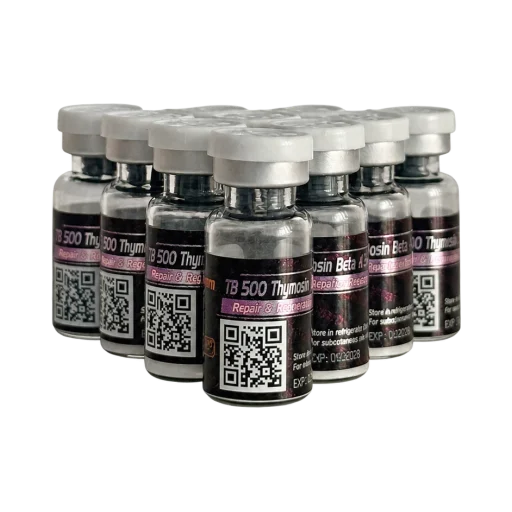

The essential context.
- A primary analytical TB-500 paper identified a seven-residue fragment; full-length thymosin beta-4 is a different molecular entity.
- Human studies of a specified thymosin beta-4 eye-drop formulation cannot establish effectiveness of an unrelated TB-500 product.
- Exact sequence, terminal modifications and formulation are essential when linking research to a catalogue item.

Why the name needs careful definition
Thymosin beta-4 and TB-500 are frequently placed in the same category, but an evidence-based description begins with molecular identity. Original sequence work characterised full-length thymosin beta-4 as a peptide of 43 amino-acid residues. In contrast, a 2012 analytical paper identified a TB-500 preparation containing the N-acetylated seven-residue sequence LKKTETQ.
This does not establish a uniform composition for every later item marketed as TB-500. A trade label can be used inconsistently. The defensible approach is to record the supplier’s exact specification and compare it with identity testing. A study name and a catalogue name are not sufficient evidence that the underlying material is identical.

Two related names, two different research questions
The shared origin of a sequence does not establish biological or clinical equivalence.
Full-length thymosin β4
A 43-residue peptide described by sequence analysis
Sequence fragment
N-acetylated LKKTETQ identified in a TB-500 preparation
Separate experiments
Each study tests a specified identity and formulation
Separate conclusions
Results remain attached to that exact material
The biological context: actin and cell movement
The fragment studied in the analytical paper corresponds to a region associated with actin binding in thymosin beta-4. Actin belongs to the cell’s structural machinery and is relevant to changes in cell shape and movement. That gives researchers a biological rationale to investigate peptide regions, their interactions and the conditions in which they act.
A fragment is not a smaller package containing every property of a full peptide. Removing sequence regions can change interactions, stability and distribution. Even where a local interaction is preserved, the whole molecule’s behaviour cannot be assumed. A mechanistic illustration should show the relationship between sequences without presenting them as interchangeable treatments.
What the TB-500 analytical study established
The 2012 study developed a liquid-chromatography/mass-spectrometry method to identify the acetylated fragment and its metabolites in equine samples. Its achievement was analytical identification in an animal context. It was not a randomised human efficacy study and did not establish a clinical treatment for tendon, ligament or muscle conditions.
Analytical detection answers whether a defined target can be distinguished in a sample using an appropriate method. It does not answer whether a person benefits from receiving the substance. Keeping those purposes separate avoids treating a sophisticated measurement technique as if it were proof of a therapeutic claim.
Human thymosin beta-4 studies: formulation and endpoints
Human research has investigated particular full-length thymosin beta-4 ophthalmic formulations. A small 2015 study in severe dry eye reported changes in selected ocular measurements and symptoms. Those findings concern an eye-drop preparation, a defined patient group and ophthalmic outcomes—not a general claim about tissue recovery throughout the body.
A separate 72-participant phase II trial is informative about interpretation. It did not show a significant difference for its two primary endpoints at the specified primary visit, while several secondary outcomes favoured the active formulation. Reporting only the positive secondary signals would hide a central limitation of that study.
Why a full-length result cannot be assigned to a fragment
To transfer a finding between products, molecular identity is only one requirement. Formulation, delivery to the target tissue, exposure and the studied population also matter. A positive observation in the cornea cannot establish a musculoskeletal outcome. Likewise, a full-length peptide result cannot establish the same effect for a fragment merely because part of the sequence overlaps.
A small later neurotrophic-keratopathy study illustrates the same boundary. Its primary four-week healing comparison involved 18 participants and did not cross the conventional statistical-significance threshold; other time points and symptoms suggested further research signals. This should not become a broad statement of “clinically proven regeneration”.
A comparison that keeps identity visible
When reading a report, check the compound specification, then the model, then the endpoint. This ordering makes it harder for a familiar name to carry a stronger conclusion than the evidence supports. It also brings unresolved product details into view before a comparison is attempted.
The catalogue can help by showing precise sequence information and batch-specific documents where available. A purity percentage does not resolve every identity or formulation question. A chromatographic result, for example, is not by itself proof of the correct sequence or an authorisation for clinical use.
| Material or study | What is defined | What must not be inferred |
|---|---|---|
| Full-length thymosin β4 | 43-residue molecular identity | Equivalence to every TB-500-labelled item |
| Analytical TB-500 preparation | N-acetylated LKKTETQ and metabolites | Human repair effectiveness |
| Ophthalmic trial formulation | Eye-drop product and ocular endpoints | Body-wide or tendon effects |
| Individual catalogue batch | What its documents actually measure | Equivalence to published research |
Frequently asked questions
Is TB-500 always full-length thymosin beta-4?
No such assumption is justified. The cited analytical study identified a seven-residue fragment. An individual product requires its own precise specification and identity evidence.
Do eye studies prove a TB-500 recovery effect?
No. They concern a specified full-length ophthalmic formulation and eye-related endpoints. Different molecules, formulations and tissues require separate evidence.
Why mention primary endpoints?
They identify the main comparisons selected to test the study question. Positive secondary findings remain relevant, but do not replace an unsuccessful primary comparison.
What should a batch document clarify?
It should identify the tested batch and method. Sequence identity, modifications, content and impurities answer different questions; the scope of each result should be explicit.
Sources & further reading
Follow the original publications and records behind this overview. Each source answers a specific question; no single record establishes every aspect of a compound or product.
- 01 Low and Goldstein (1982): chemical characterisation and 43-residue sequence of thymosin beta-4
- 02 Ho et al. (2012): analytical identification of N-acetylated LKKTETQ in TB-500
- 03 Sosne et al. (2015): small phase II trial in severe dry eye
- 04 Sosne and Ousler (2015): 72-participant ophthalmic phase II trial
- 05 Sosne et al. (2022): RGN-259 trial in neurotrophic keratopathy
Dr. Monica Tatem
Dr. Monica Tatem earned her Ph.D. in Molecular Pharmacology from a leading medical university, followed by postdoctoral research focused on anabolic pathways and cellular signaling. Her scientific work encompasses a comprehensive...
View author profile