
The essential context.
- A receptor-independent cell effect prevents a simple one-target explanation.
- The SARMs and related compounds category is a catalogue group, not a shared pharmacological class.
- Source products and clinical or laboratory study material must not be assumed equivalent.
What SR-9009 is
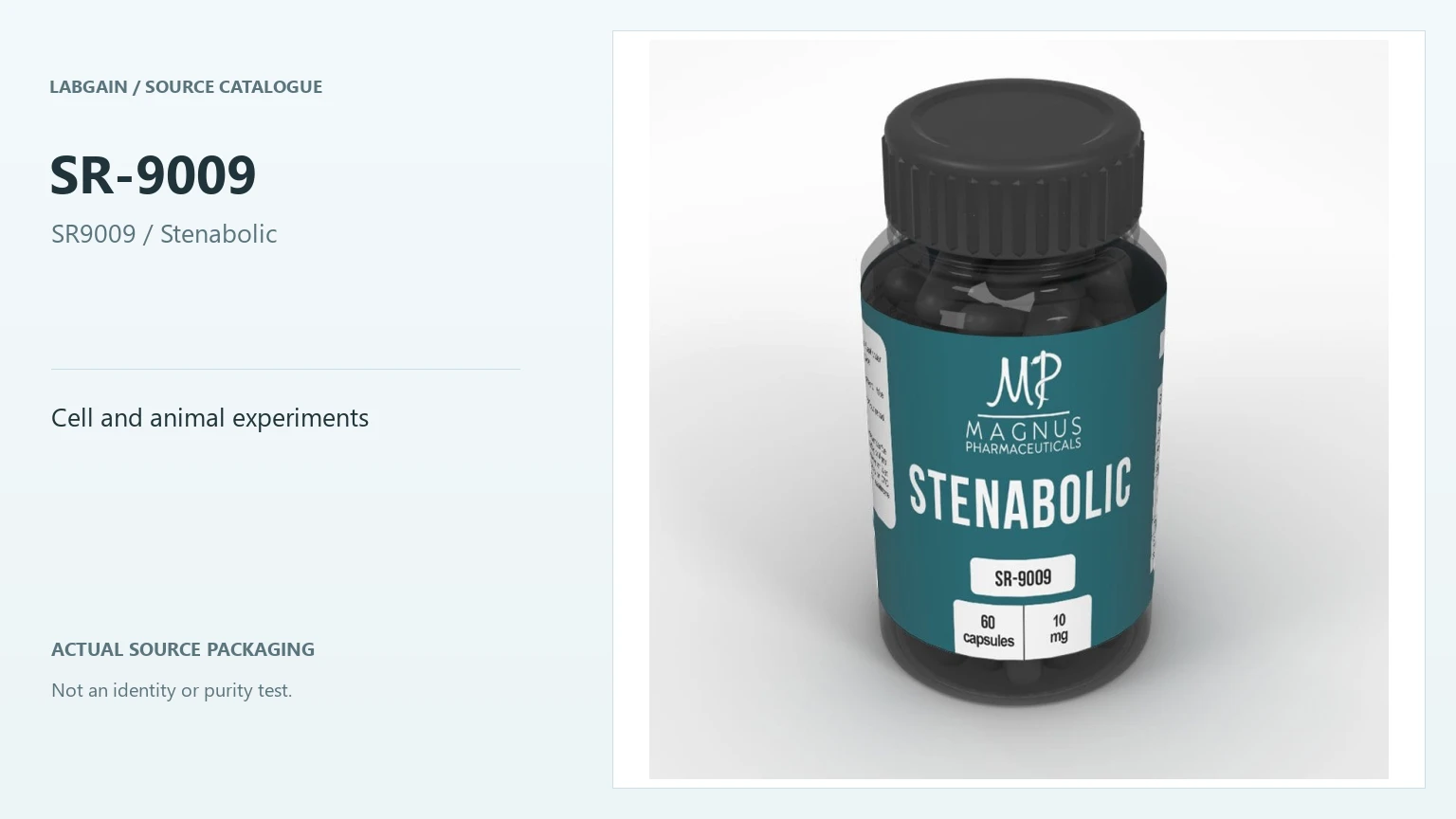
SR-9009 is an experimental small molecule often called Stenabolic. It is associated with REV-ERB and circadian-metabolism research, rather than the androgen receptor mechanism that defines SARMs. The term agonist requires care because a compound can influence more than the receptor used to describe it. Supplier category names do not resolve that mechanistic uncertainty.
SR-9009: target, model and open question
Conceptual overview without a dose, measurement curve or chemical structure.
REV-ERB-associated and off-target effects
REV-ERB research probe — not a SARM
Studied model
Cell and animal experiments
Interpretation limit
A receptor-independent cell effect prevents a simple one-target explanation.
What the named research shows
Solt and colleagues, Nature (2012; DOI 10.1038/nature11030), reported circadian and metabolic experiments. Dierickx and colleagues, PNAS (2019; DOI 10.1073/pnas.1904226116), later demonstrated effects even without REV-ERB in tested cells. Target attribution is therefore an important limitation.
A receptor-independent cell effect prevents a simple one-target explanation.
Why it is discussed in sport
Sport-oriented discussions often describe SR-9009 as an endurance or fat-loss compound. The leap from altered cellular metabolism to a meaningful advantage during human exercise is not established by those papers. An effect observed in a cell without the proposed receptor also weakens a simple marketing story about a precisely targeted body clock. It raises questions for experimental design rather than proving a better training outcome.
Risks and unresolved questions
A research probe is not a completed human safety assessment. Effects outside the proposed target make it harder to infer which pathway accounts for a benefit or a harm. The cited evidence does not establish a safe human exposure, long-term organ safety or predictable interactions. Calling SR-9009 non-hormonal does not answer these questions and should not be used as a safety guarantee.
Reading product claims alongside evidence
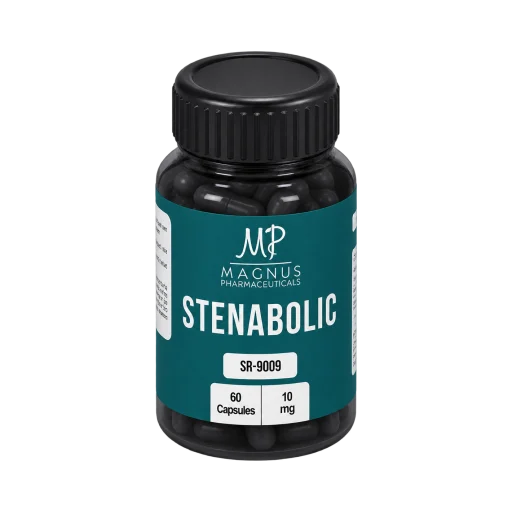
A research publication and a retail product answer different questions. The image shows the actual source packaging for recognition. It does not confirm contents, purity, sterility or suitability. A particular batch would require traceable sampling, identity testing and appropriate analytical documentation. A percentage printed on a label alone does not replace that documentation.
This overview separates observed results from extrapolation to athletes. It provides no use protocol. Potential benefits are described as studied signals or as claims in sporting discussions; missing long-term data are not treated as reassurance. New publications can change the assessment. The draft still requires editorial review before publication.
Frequently asked questions
Is SR-9009 actually a SARM?
REV-ERB research probe — not a SARM. Classification follows pharmacology rather than the name of a supplier category.
Do the cited studies establish a safe sports benefit?
A receptor-independent cell effect prevents a simple one-target explanation. Study populations, endpoints and observation periods limit the conclusion. A photograph or trade name does not resolve those gaps.
Sources & further reading
Follow the original publications and records behind this overview. Each source answers a specific question; no single record establishes every aspect of a compound or product.
- 01 Solt et al., synthetic REV-ERB experiments, Nature 2012; DOI 10.1038/nature11030
- 02 Dierickx et al., SR9009 target-independent effects, PNAS 2019; DOI 10.1073/pnas.1904226116
- 03 NVWA-IOD: SARMs enforcement notice, 16 May 2025
Dr. Monica Tatem
Dr. Monica Tatem earned her Ph.D. in Molecular Pharmacology from a leading medical university, followed by postdoctoral research focused on anabolic pathways and cellular signaling. Her scientific work encompasses a comprehensive...
View author profile