
The essential context.
- Human obesity research supports weight reduction, not a proven athletic advantage.
- Appetite suppression can conflict with fuelling and recovery; a lighter body is not automatically a better-performing body.
- Study medication, an online vial and an approved finished medicine are different evidence questions.

Why retatrutide appears in sporting discussions
Retatrutide is discussed in physique and weight-sensitive sports because reducing body fat can change appearance and the mass an athlete carries. These are reported reasons for interest, rather than established sporting indications. Someone seeking treatment for obesity has a different clinical question from a lean athlete seeking a lower competition weight. The relevant comparison must therefore include health, training capacity and recovery, not only a photograph or a scale reading. A medicine that changes appetite should not be described as a substitute for a sports nutrition assessment.
From a metabolic target to a sporting claim
Each step requires its own evidence.
Receptors
A biological mechanism
Clinical outcome
Weight and health in a defined population
Body composition
Separate fat and lean-tissue questions
Performance
Strength and endurance require direct testing
What the receptor mechanism can and cannot explain
Retatrutide combines activity at GIP, GLP-1 and glucagon receptors in one investigational molecule. Coskun and colleagues described its development in Cell Metabolism in 2022. This receptor profile helps explain the metabolic research programme, but three targets do not mean three times the sporting benefit. Mechanism alone cannot establish preservation of muscle, improved sprint output or faster return from injury. Those claims require direct measurements in the intended population, alongside adverse events and a meaningful comparator.
Named studies: strong weight-loss evidence, different population
Jastreboff and colleagues' 2023 New England Journal of Medicine phase 2 trial included 338 adults with obesity and followed treatment for 48 weeks. Weight reduction exceeded placebo; gastrointestinal adverse events and changes in heart rate were relevant observations. Participants were not a trained-athlete performance cohort.
The 2026 TRIUMPH-1 paper by Jastreboff and colleagues in the same journal randomised 2,339 adults with obesity without diabetes over 80 weeks. It reported weight reduction and benefits in prespecified knee-osteoarthritis and sleep-apnoea subgroups. These are substantial clinical outcomes, but they do not demonstrate muscle hypertrophy, sporting recovery or an endurance advantage. A painful knee in an obesity trial is not equivalent to an athlete's acute tendon injury.
Potential advantages and the trade-offs for training
For an appropriately selected patient, improvement in obesity-related health may make movement and participation more manageable. That possibility should not be repackaged as an ergogenic effect. In sporting terms, lower mass can have competing consequences: a body-composition change may reduce mechanical load while inadequate intake can undermine the ability to train. Whether an individual benefits depends on their starting health and on functional outcomes. Claims of selective fat loss or guaranteed muscle preservation go beyond the trials described here.
| Claim | Evidence | Limit |
|---|---|---|
| Fat loss | Weight reduction in obesity trials | Not selective preservation of muscle |
| Better recovery | Not established by these trials | Pain outcomes are not injury-healing outcomes |
| Higher performance | No direct evidence in the cited athletic setting | Lower mass is not a functional test |
Risks that matter in an active person
Nausea, vomiting, diarrhoea or persistent poor appetite can interfere with meals, hydration and completion of training. Dehydration or under-fuelling in a demanding training setting are reasonable clinical concerns, not quantified benefits or harms established in these obesity trials. Changes in heart rate deserve clinical interpretation rather than being dismissed as evidence of a faster metabolism. Longer-term safety, interactions and individual tolerability cannot be inferred from somebody else's progress photographs. Unverified product identity adds a separate uncertainty to the pharmacological risk.
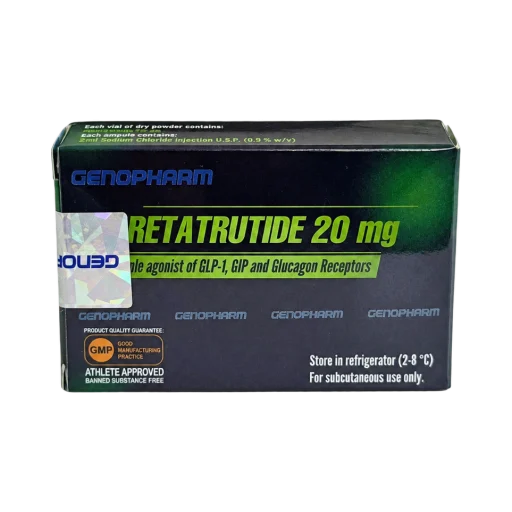
The Australian TGA reported in September 2026 that a vial sold as retatrutide contained semaglutide and no retatrutide. That tested sample illustrates a product-identity risk; it is not a test result for every product.
How to read a claim responsibly
Ask what was measured: total weight, fat mass, lean tissue, symptoms or an actual sporting task. Lean tissue measured by a scanner is not the same as muscle strength. Also ask whether an effect persisted, who withdrew and whether the comparison used the same follow-up period. The studies cited here support discussion with a qualified clinician about metabolic disease; they do not provide a self-directed sporting regimen. Athletes must separately check their governing body's current medication and anti-doping requirements.
Frequently asked questions
Does weight loss prove muscle preservation?
No. Weight alone does not identify which tissues changed, and a lean-mass measurement does not establish strength.
Does the knee study show sports-injury healing?
No. An osteoarthritis pain endpoint in adults with obesity cannot establish tendon or ligament repair in athletes.
Sources & further reading
Follow the original publications and records behind this overview. Each source answers a specific question; no single record establishes every aspect of a compound or product.
- 01 Jastreboff et al. (2023), NEJM: phase 2 retatrutide obesity trial; PMID 37366315
- 02 Jastreboff et al. (2026), NEJM: TRIUMPH-1; DOI 10.1056/NEJMoa2604169
- 03 Coskun et al. (2022), Cell Metabolism: discovery and receptor pharmacology; PMID 35985340
- 04 TGA (14 September 2026): counterfeit retatrutide product laboratory test and serious adverse event
Dr. Monica Tatem
Dr. Monica Tatem earned her Ph.D. in Molecular Pharmacology from a leading medical university, followed by postdoctoral research focused on anabolic pathways and cellular signaling. Her scientific work encompasses a comprehensive...
View author profile