

The essential context.
- The Roman numeral II identifies a specific compound, not a quality grade or a stronger version of another medicine.
- Small pigmentation and physiological-response studies are not evidence of established long-term safety.
- Afamelanotide in Scenesse is a different molecule in a specific authorised medicine.
A name that needs precise identification
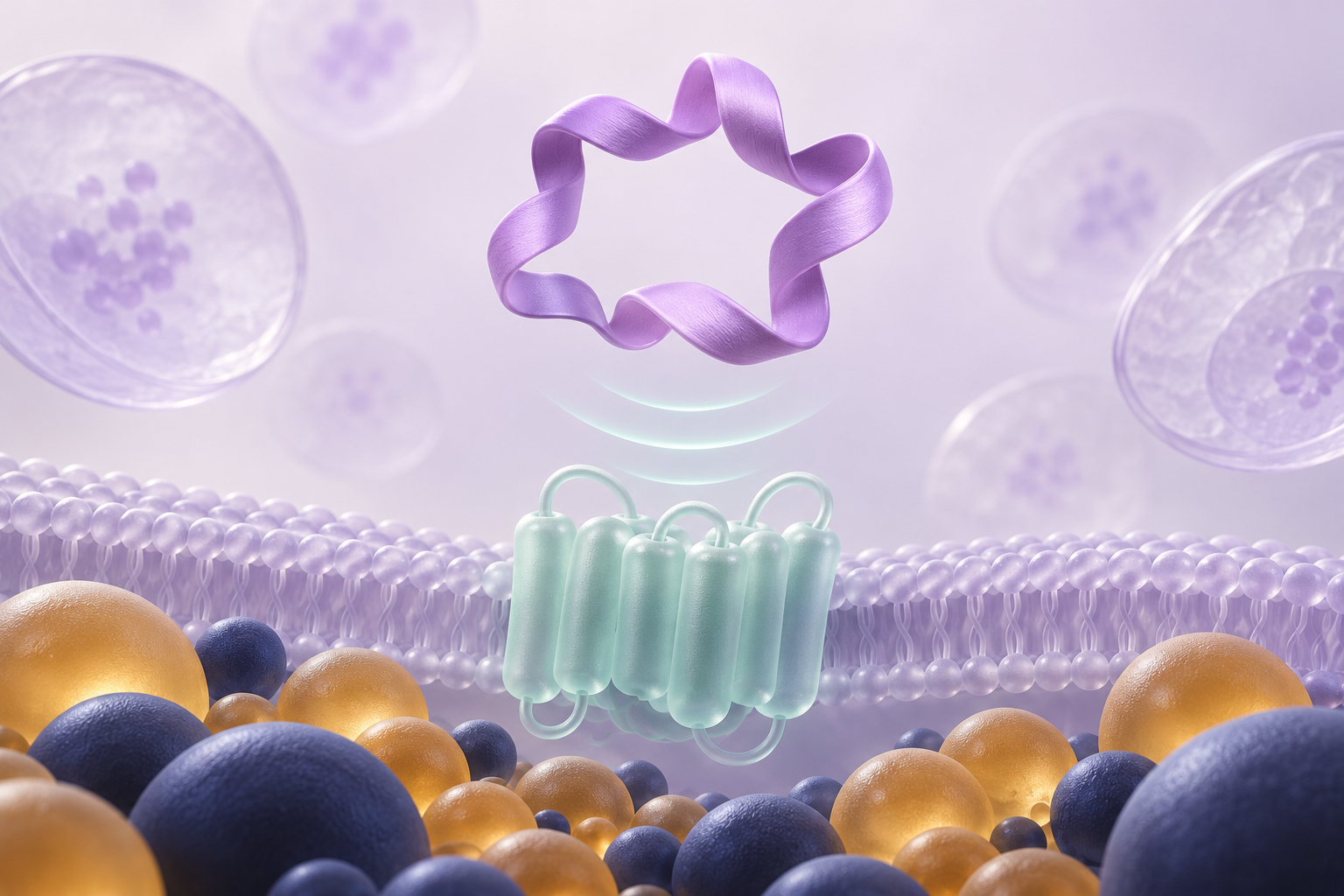
Melanotan II, also written MT-II, is a synthetic cyclic heptapeptide related to alpha-melanocyte-stimulating hormone, or α-MSH. “Cyclic” describes part of its molecular architecture; it does not describe how it is supplied or used. The suffix II matters because similarly named melanocortin compounds are not automatically the same chemical entity.
Chemical identity should come before a list of claimed effects. A compound name connects a reader to a specific research literature, whereas a product label connects to a particular supplied item. Moving from one to the other requires evidence, rather than an assumption that similar spelling establishes equivalence.

From a cyclic peptide to a research observation
This evidence chain separates molecular identity, a biological signal and the interpretation of a small study.
Melanotan II
A cyclic α-MSH analogue
Melanocortin signalling
Biological pathways under investigation
Early observations
Pigmentation and other responses
Evidence limits
Small samples; no product authentication
What the early pigmentation study actually examined
A 1996 pilot phase 1 study involved three male volunteers. It explored physiological responses and pigmentation after exposure to MT-II. The publication reported increased pigmentation in two participants, together with effects including nausea, fatigue and a stretching/yawning response. Its very small size is central to understanding what the study can and cannot establish.
An early proof of a biological response is not a complete benefit–risk assessment for a general population. Rare events, a wide range of skin types and prolonged exposure require different evidence. The sensible reading of this paper is that it generated research observations, not that it validated an everyday cosmetic product.
Why the literature extends beyond pigmentation
Other small human studies investigated physiological responses in men with erectile dysfunction. A 1998 placebo-controlled crossover study enrolled ten men with psychogenic erectile dysfunction; a later study examined men with organic risk factors. These papers illustrate that MT-II research has not been restricted to changes in skin colour.
The scientific lesson is broader than any single observed response: a compound associated with one visible effect may act in more than one physiological context. A simple “tanning peptide” description can conceal this complexity. Findings in a small selected group do not establish effects or safety in everyone else.
Pigmentation is not a sun-protection claim
An observed change in pigmentation and a validated claim about protection against ultraviolet injury are different endpoints. The Danish Medicines Agency issued a warning about online Melanotan tanning products in 2011, describing the lack of approval and insufficient evidence for the advertised effects. That is a dated regulatory warning, not a newly completed clinical evaluation.
Historical research titles sometimes contain terms such as “potential” or name a hoped-for use. Those words describe a research objective, not proof that the objective has been achieved. Reading the actual methods and measured endpoints helps prevent a proposed mechanism from turning into an unsupported claim about cancer prevention or sun protection.
Melanotan II and afamelanotide are not interchangeable
The current EMA record for Scenesse identifies its active substance as afamelanotide and its indication as prevention of phototoxicity in adults with erythropoietic protoporphyria. This is a named medicine for a specific disease, with its own assessed product information. It is not a general authorisation of every melanocortin analogue.
The distinction is important when a page cites a legitimate medicine to support a different product. Similar research ancestry does not establish the same molecule, formulation or indication. The spelling of the active substance and the finished product should both be checked before interpreting an authorisation claim.
| Term | What it identifies | What it does not establish |
|---|---|---|
| Melanotan II / MT-II | A particular cyclic peptide | Equivalence to afamelanotide |
| Afamelanotide | A different active substance | Authorisation of MT-II |
| Scenesse | A named authorised medicine | Approval of generic tanning products |
What an analytical result can show
Analytical research has developed HPLC methods for measuring MT-II in experimental samples. Such work highlights a basic principle: a concentration result is meaningful only within the method, sample and validation described. Detecting a peptide in a biological sample is a different task from fully characterising a commercial product.
For an item in a catalogue, the useful questions are specific. Is the test connected to the stated batch? Does it establish identity, nominal content or only a chromatographic percentage? Are the report’s date and scope clear? These questions do not prejudge a result; they make its meaning understandable and keep a demonstration certificate from becoming a scientific claim.
Frequently asked questions
Is Melanotan II another name for Scenesse?
No. Scenesse contains afamelanotide. MT-II is a different compound; the medicine’s authorisation should not be extended to it.
Does the early pigmentation study establish long-term safety?
No. The pilot involved three volunteers. Its observations cannot establish uncommon or long-term effects in a broad population.
Sources & further reading
Follow the original publications and records behind this overview. Each source answers a specific question; no single record establishes every aspect of a compound or product.
- 01 Dorr et al., Life Sciences (1996): pilot phase 1 study
- 02 Wessells et al., Journal of Urology (1998): placebo-controlled crossover study
- 03 Wessells et al., Urology (2000): study in men with organic risk factors
- 04 Danish Medicines Agency (2011): warning about Melanotan products
- 05 Lan et al., Journal of Pharmaceutical Sciences (1994): MT-II preformulation research
- 06 EMA: Scenesse / afamelanotide assessment and product information
- 07 Ugwu and Blanchard, Journal of Chromatography (1992): analytical measurement in rat plasma
- 08 Ryakhovsky et al., Beilstein Journal of Organic Chemistry (2008): MT-II chemistry
Dr. Monica Tatem
Dr. Monica Tatem earned her Ph.D. in Molecular Pharmacology from a leading medical university, followed by postdoctoral research focused on anabolic pathways and cellular signaling. Her scientific work encompasses a comprehensive...
View author profile