

The essential context.
- More collagen in a model does not establish stronger or better-functioning athletic tissue.
- Skin-formulation findings do not establish the safety of systemic exposure.
- The biological rationale is distinct from evidence for an individual catalogue preparation.
Why collagen research is attractive in sport
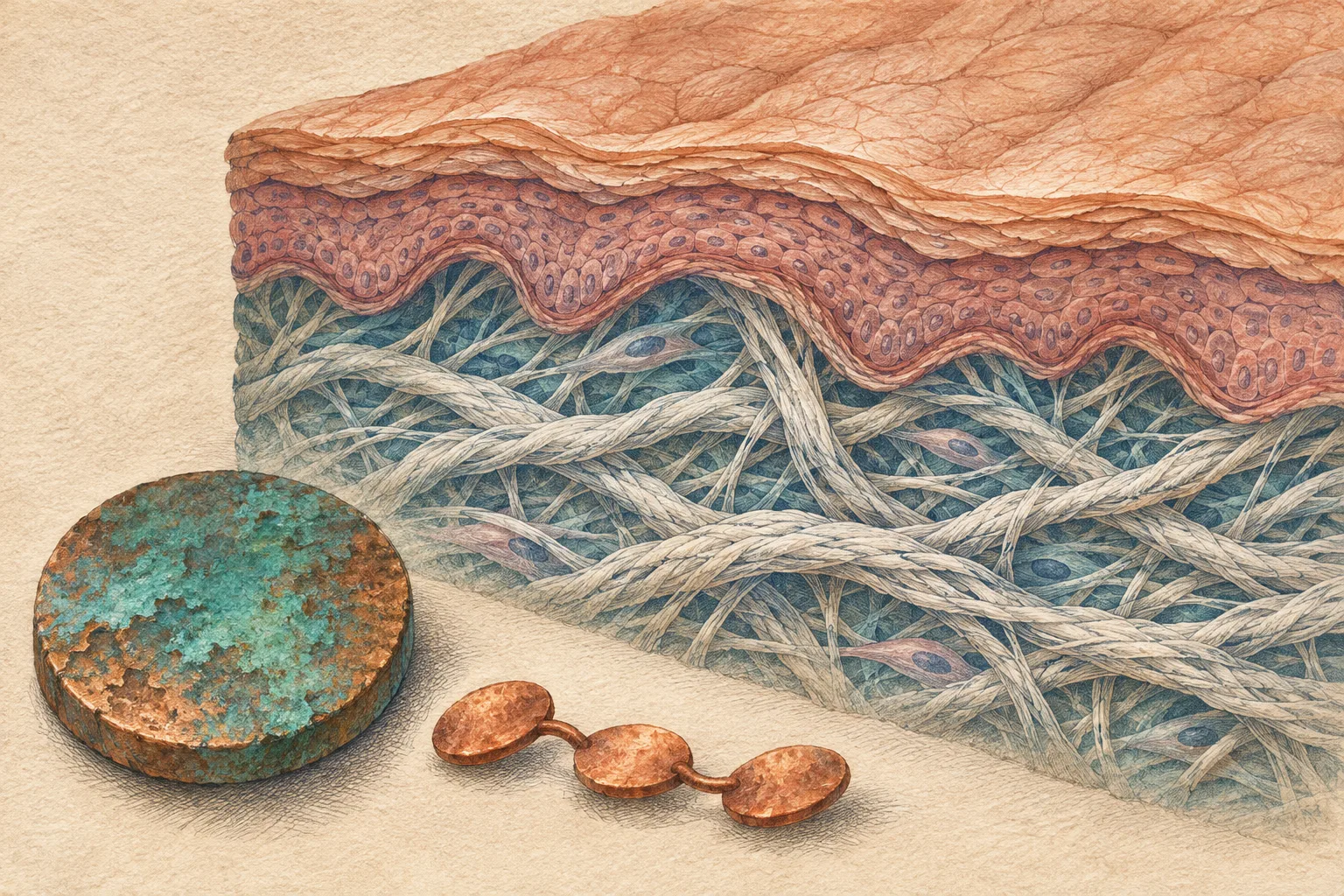
The sports interest in GHK-Cu is usually linked to connective tissue, persistent soft-tissue complaints or skin recovery. Collagen is an appealing term because tendons, ligaments and skin all involve extracellular matrix. But an ingredient that changes a collagen measure in one experimental setting is not automatically a treatment for every tissue containing collagen.
The sporting question must be specific. Is the proposed advantage less pain, stronger healed tissue, improved skin appearance or faster return to activity? These are different outcomes, and a positive finding in one cannot quietly serve as proof of the others. The cited literature supports research interest rather than a general repair promise.
From collagen signal to athlete benefit
Each level requires a different kind of evidence.
Cell signal
Collagen synthesis in cultured fibroblasts
Tissue model
Experimental wounds and ex-vivo skin
Clinical relevance
A specific tissue and formulation need human study
Sport outcome
Function, loading tolerance and safety
The original fibroblast result
Maquart and colleagues’ 1988 FEBS Letters paper reported increased collagen synthesis in fibroblast cultures exposed to GHK-Cu. This is a concrete laboratory observation involving a copper-binding tripeptide, not a trial of strength, injury recovery or sporting function. Cell number and collagen synthesis also represent different measurements.
Cultured cells do not reproduce the loading, blood supply, tissue organisation and whole-body regulation of an athlete. Even a reproducible increase in collagen production would need subsequent evidence that the resulting tissue is appropriately organised, mechanically useful and clinically beneficial. More of a matrix component is not automatically better performance.
Animal wound and modern skin-formulation studies
Maquart and colleagues’ 1993 Journal of Clinical Investigation study used experimental wound chambers in rats. It reported changes in connective-tissue accumulation and related biochemical measures. This extends the work beyond isolated cells but still does not test human tendon rehabilitation, repeated training or return to competition.
Jiang and colleagues’ 2023 Journal of Cosmetic Dermatology paper studied GHK-Cu with hyaluronic acid in fibroblasts and ex-vivo skin. A combined formulation and its skin endpoint are part of that result. It cannot establish the effects of GHK-Cu alone in injured muscle, or validate a different product, exposure or delivery system.
Potential advantages and the clinical gap
The plausible research advantage is an influence on repair-associated matrix biology. Whether that becomes improved healing or appearance depends on the tissue, formulation and clinical setting. A sporting benefit would need direct evidence of better function, adequate load tolerance or another meaningful result beyond a suitable comparison.
None of these papers establishes that an athlete becomes stronger, gains muscle or safely shortens rehabilitation. Cosmetic interest is also separate from systemic sports use. The same chemical name on a topical preparation and a vial does not make their exposures or benefit-risk balances equivalent.
| Claim | What was measured | What it does not prove |
|---|---|---|
| Connective-tissue support | Collagen-related laboratory outcomes | Athletic tendon strength |
| Wound repair | Rat experimental wound tissue | Faster human rehabilitation |
| Skin formulation benefit | Combined ex-vivo skin results | Systemic safety or sports efficacy |
Safety questions cannot be borrowed from skin care
Limited human information leaves uncertainty about uncommon reactions, long-term systemic effects and interactions in sporting users. FDA’s safety discussion of compounded injectable GHK-Cu highlights immunogenicity and limited human data. This is not a statement about a current compounding-category entitlement or proof of a particular inevitable adverse event.
Copper binding is part of the molecule’s identity, not a reason to assume any amount or formulation is harmless. The uncomplexed peptide, its copper complex and a combined skin formula require separate characterisation. Unverified content, impurities and contamination add product risks that cell-culture findings do not address.
Tissue quality matters as much as tissue quantity
In sport, connective tissue must do more than contain collagen. It has to transmit force, tolerate repeated loading and function with the surrounding structures. The laboratory and experimental-wound papers did not measure a completed sporting rehabilitation process, so their biochemical findings cannot determine readiness for demanding activity.
That distinction helps interpret both enthusiasm and scepticism. A positive collagen finding can be real and scientifically useful without establishing a worthwhile athlete benefit. A meaningful clinical test would examine the relevant tissue’s function and the person’s ability to resume activity, while also recording harms. An attractive mechanism should therefore guide questions for research rather than replace evidence about actual tissue performance.
What a useful sporting conclusion looks like
A careful evaluation keeps laboratory collagen findings, experimental wound repair and human athletic outcomes in separate columns. It also separates improvements in appearance or symptoms from the mechanical readiness of a tendon or ligament. Persistent injury symptoms require their own diagnosis rather than the assumption that a collagen-promoting narrative identifies the problem.
For regulated sport, the exact substance, formulation and current rules need independent assessment; this article provides no eligibility guarantee. The present balance is a recognisable experimental rationale with a major clinical translation gap. A verified athlete trial with function and adequate safety follow-up would be more informative than another broad repair claim.
Frequently asked questions
Does more collagen mean stronger tendons?
Not automatically. Tissue organisation, mechanical properties and clinical function must be assessed directly.
Can skin-care experience establish systemic safety?
No. Formulation, exposure and delivery affect the benefit-risk question.
Did the 2023 study test athletic recovery?
No. It investigated a GHK-Cu and hyaluronic-acid combination in fibroblast and ex-vivo skin systems.
Sources & further reading
Key publications are named below. The article explains their design, study population and limitations, keeping laboratory findings, clinical results and sports claims in context.
- 01 Maquart et al. (1988), FEBS Letters: GHK-Cu and collagen synthesis in cultured fibroblasts; PMID 3169264
- 02 Maquart et al. (1993), Journal of Clinical Investigation: GHK-Cu in rat experimental wounds; PMID 8227353
- 03 Jiang et al. (2023), Journal of Cosmetic Dermatology: GHK-Cu with hyaluronic acid in fibroblast and ex-vivo skin tests; PMID 37062921
- 04 FDA safety review: limited human data and immunogenicity concerns for compounded injectable GHK-Cu; checked November 2026
Dr. Monica Tatem
Dr. Monica Tatem earned her Ph.D. in Molecular Pharmacology from a leading medical university, followed by postdoctoral research focused on anabolic pathways and cellular signaling. Her scientific work encompasses a comprehensive...
View author profile