
The essential context.
- Experimental studies examine several repair-associated signals, rather than establishing a single clinically validated mechanism.
- Small human reports cannot determine effectiveness or reliably exclude uncommon harms.
- The name on a label does not authenticate the contents or establish pharmaceutical quality.

What BPC-157 is—and what the name leaves open
BPC-157 is a synthetic pentadecapeptide: a peptide containing 15 amino-acid residues. Its experimental literature includes connective-tissue biology, vascular responses and injury models. A sequence-based description identifies the research subject more precisely than phrases such as “recovery peptide”. It does not establish that every product using the name contains the same material.
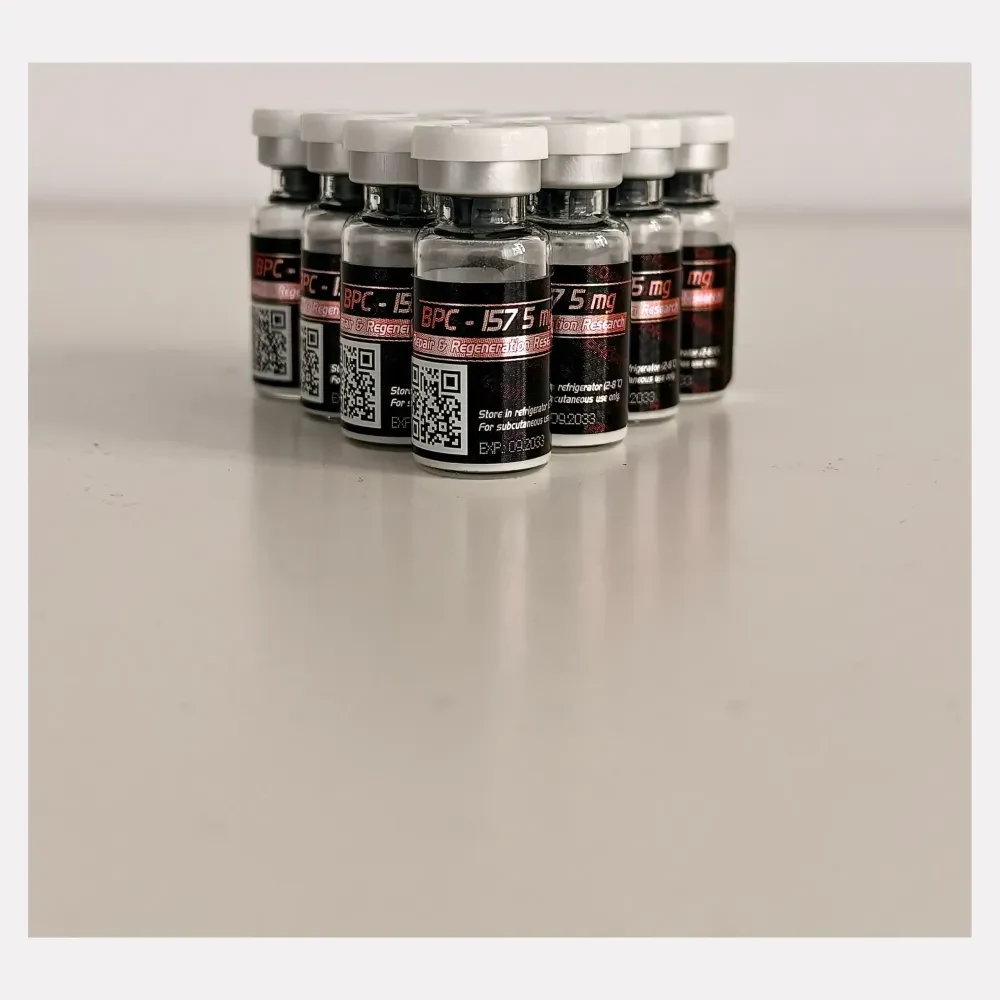
For an individual catalogue item, identity, amount and quality remain separate questions. A molecular-identity test can address the first; a quantitative assay can address labelled content. Neither automatically supplies evidence of sterility, absence of endotoxins or suitability for a particular clinical purpose. These distinctions matter when comparing a published experiment with a commercial vial.

Following the evidence, one step at a time
Read this as a research map. The arrows connect questions and measurements, not a proven treatment pathway.
Research material
A peptide identified as BPC-157
Experimental model
Tendon cells or an induced animal injury
Measured response
Migration, signalling or tissue mechanics
Clinical question
Would a meaningful, safe human benefit follow?
How tendon-cell experiments are interpreted
A 2014 study used fibroblasts isolated from rat Achilles tendons. The investigators observed increased growth-hormone-receptor expression and examined downstream signalling when growth hormone was present. This provides a specific experimental observation about cells and conditions; it is not evidence that BPC-157 replaces growth hormone or treats a human tendon injury.
Cell migration, proliferation and gene expression answer different questions. More cells in an assay do not establish organised collagen alignment, appropriate load-bearing capacity or a better patient outcome. A useful reading of a mechanistic paper asks what was measured, in which species, and whether the change was connected to a functional result.
What animal studies add
A rat Achilles-tendon study reported differences in biomechanical, functional and tissue-level assessments after an experimentally induced injury. Another study examined angiogenesis-related observations in muscle and tendon models and found that the vascular response depended on the experimental setting. These are research directions rather than a universal repair effect.
An induced injury is a controlled system. Human tendon disorders can involve ageing, chronic degeneration, repeated loading and metabolic disease—conditions not reproduced by a single laboratory injury. Replication, model diversity and a clear bridge to human outcomes are needed before translating an animal result into a clinical conclusion.
Human reports: signals with important limits
A 2021 retrospective knee-pain report contacted 16 people, including participants who received a combination with another peptide. It had no randomised comparison and used retrospective symptom reporting rather than validated functional outcome tools. It can generate a question for a future trial, but cannot reliably distinguish a treatment effect from other explanations.
A separate 2025 safety pilot involved only two people and a short observation period. The authors reported no adverse effects in the measurements they collected. That should be described at its actual scale: a small tolerability observation, not a demonstration of general safety, long-term safety or effectiveness for musculoskeletal recovery.
A practical way to compare the research
Start with the outcome rather than the headline. A cell-signalling change, a tissue-strength measurement and a person’s pain rating sit at different levels of evidence. A useful overview keeps those levels visible and does not combine them into a single “success rate”.
The comparison below distinguishes what each approach observes directly from the questions that require additional evidence. This matters when a compound is discussed across unrelated organs and conditions: a result in one model does not establish the same result elsewhere.
| Research setting | Useful observation | What remains unresolved |
|---|---|---|
| Tendon-cell culture | Receptor expression and signalling | Human function and clinical safety |
| Rat injury model | Tissue mechanics and recovery measures | Transferability to chronic human disease |
| Retrospective human report | Reported symptom changes | Comparative effectiveness and bias |
| Two-person pilot | Short-term measured tolerability | Uncommon harms and longer-term outcomes |
Open questions that would change the conclusion
Useful next evidence would connect a defined, characterised product to a prespecified patient-relevant outcome in an adequately controlled study. Follow-up should be long enough for the intended outcome, while reporting both favourable and unfavourable events. Independent confirmation matters because a result should not depend on one laboratory or clinical setting.
Formulation, impurities, stability and consistency also remain product-specific. Research on the molecule cannot resolve them for unrelated material. Likewise, a certificate for one batch cannot establish clinical effectiveness. A transparent catalogue links available documents to the actual batch and states what each document measured.
Frequently asked questions
Does a tendon study prove that BPC-157 repairs human injuries?
No. The cited experiments used rat cells or animal injury models. Their outcomes develop hypotheses; human effectiveness needs direct clinical testing.
Does the two-person pilot establish safety?
It reports observations made in two participants over a short period. It cannot reliably measure rare events, long-term effects or safety in other populations.
Are BPC-157 and TB-500 interchangeable?
No. They are different peptide identities. A combination report does not establish equal properties or show that one can substitute for the other.
What does the mg value on a product mean?
It describes the labelled amount in that item, rather than a clinical-use instruction. Independent measurement is needed to substantiate the amount in a particular batch.
Sources & further reading
Follow the original publications and records behind this overview. Each source answers a specific question; no single record establishes every aspect of a compound or product.
- 01 Chang et al. (2014): growth-hormone-receptor expression in rat tendon fibroblasts
- 02 Staresinic et al. (2003): transected rat Achilles-tendon model
- 03 Experimental study (2010): angiogenesis in muscle and tendon models
- 04 Lee and Padgett (2021): retrospective knee-pain report
- 05 Lee and Burgess (2025): two-participant BPC-157 safety pilot
Dr. Monica Tatem
Dr. Monica Tatem earned her Ph.D. in Molecular Pharmacology from a leading medical university, followed by postdoctoral research focused on anabolic pathways and cellular signaling. Her scientific work encompasses a comprehensive...
View author profile