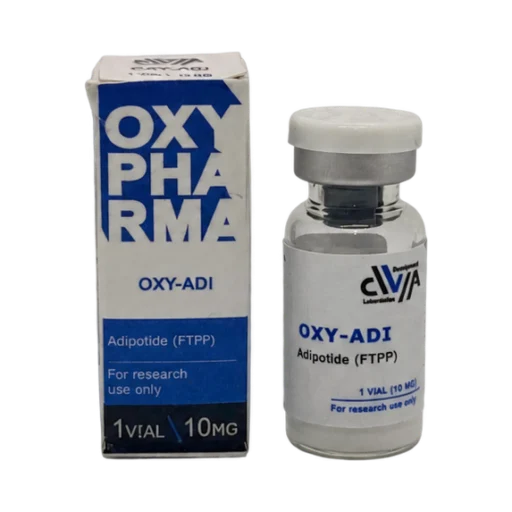

The essential context.
- Adipotide targets the vasculature associated with white adipose tissue, not an appetite pathway.
- Weight reduction in obese animals is not evidence of a safe physique intervention in people.
- Kidney findings in the primate study are central to the risk assessment.

Why the fat-targeting story attracts attention
The appeal of adipotide in physique discussions is the idea of acting directly on fat tissue rather than relying on appetite reduction. That is a description of the marketing narrative, not an established sporting use. A biological target associated with fat does not guarantee selective cosmetic improvement or protection of other organs. In a healthy person, especially someone already relatively lean, the acceptable risk is not defined by a dramatic animal weight-loss figure. A sports article must put organ safety alongside the claimed effect from the start.
Read efficacy and toxicity together
Both observations belong to the same assessment.
Vascular target
An experimental biological strategy
Animal fat change
Preclinical efficacy signal
Renal findings
An organ-safety warning
Human sport
No established safe benefit in the cited evidence
A vascular-targeting mechanism deserves careful language
Adipotide is a peptidomimetic associated with prohibitin-targeting research. The National Cancer Institute describes prohibitin-targeting peptide 1 as a construct designed to affect white-adipose vasculature through a cell-death mechanism. This is a different concept from temporarily changing appetite or enhancing a normal training adaptation. Describing it as simply helping the body burn fat hides that difference. A plausible targeting strategy is a starting point for toxicology and clinical development, rather than a guarantee that effects stay confined to the desired tissue.
The named animal studies
Kolonin and colleagues' 2004 Nature Medicine paper described targeted ablation of adipose tissue in mice and helped establish interest in prohibitin-associated vascular targeting. Its experimental model is important: it was not evidence from people preparing for sport.
Barnhart and colleagues' 2011 Science Translational Medicine study investigated adipotide in obese monkeys and reported weight and metabolic changes. The same paper described renal tubular effects and injury-related findings. Improvement during a recovery period in that experiment does not establish that human exposure is safe or that kidney injury would always be reversible. These results must be read together rather than extracting the weight result and relegating toxicology to a footnote.
What could count as a benefit, and what does not
A successful future metabolic therapy would need clinically meaningful outcomes and an acceptable safety profile in humans. Preclinical fat loss alone satisfies neither requirement. For sport, claims about preserving muscle, improving work capacity or recovering faster are additional questions that the cited studies do not resolve. Reducing an animal's adipose tissue cannot establish a useful athletic trade-off. The argument that monkeys are close to humans improves the relevance of both efficacy and toxicity observations; it cannot selectively validate the favourable result while dismissing the warning.
| Claim | Evidence | Limit |
|---|---|---|
| Targeted fat loss | Preclinical vascular-targeting studies | Not a validated human cosmetic treatment |
| Metabolic improvement | Observed in the primate disease model | Does not establish athletic function |
| Acceptable safety | Not established for athletes | Kidney toxicity was reported in the same study |
The kidney risk and the wider uncertainty
The primate kidney findings make descriptions such as gentle or low-risk inappropriate. Renal function matters to fluid and electrolyte regulation, and an experimental compound's organ toxicity is not made acceptable by a sporting objective. The available work does not define a safe consumer exposure, interaction profile or long-term outcome for athletes. Nor can a purity percentage on a certificate answer these clinical questions. A correctly identified compound may still be hazardous; a misidentified or contaminated one introduces further uncertainty.
A proportionate conclusion for sport
The evidence gives a reason to study the mechanism and a strong reason not to confuse preclinical efficacy with a proven physique treatment. The references reviewed here do not establish safe athletic use, and they provide no basis for a self-directed programme. A named substance in a catalogue should not be described as equivalent to supervised research material. Readers comparing claims should ask whether human functional outcomes and organ safety were actually measured, rather than treating an impressive animal result as a recommendation.
Frequently asked questions
Does the primate study make adipotide a proven sports treatment?
No. It is an animal study and reported kidney findings as well as weight changes.
Does reversibility in monkeys guarantee recovery in people?
No. Species, exposure and clinical circumstances differ; a human safety margin is not established.
Sources & further reading
Follow the original publications and records behind this overview. Each source answers a specific question; no single record establishes every aspect of a compound or product.
- 01 Kolonin et al. (2004), Nature Medicine: targeted adipose-tissue ablation in mice; PMID 15133506
- 02 Barnhart et al. (2011), Science Translational Medicine: adipotide in obese monkeys; PMCID PMC3666164
- 03 US National Cancer Institute: prohibitin-targeting peptide 1 drug dictionary entry
Dr. Monica Tatem
Dr. Monica Tatem earned her Ph.D. in Molecular Pharmacology from a leading medical university, followed by postdoctoral research focused on anabolic pathways and cellular signaling. Her scientific work encompasses a comprehensive...
View author profile